 EN |
 IT
 ES
 RU
 ZH
 HE

Investment diamonds: how to read a GIA report
Published on
When you buy a diamond as an investment, you are not just buying a stone: you are also buying the document that describes its qualities. The best known in the world is issued by the GIA (Gemological Institute of America), the American nonprofit institute that created the grading system the whole industry uses today. Knowing how to read it is the first step to understanding what you are buying.

The “4Cs”: color, clarity, cut and carat weight
The report for a white diamond gives four assessments, known as the “4Cs”.
- Color. It is measured on a letter scale from D to Z, introduced by the GIA in 19531. D is the top grade and means a completely colorless diamond; towards Z the stone shows a light yellow, brown or gray tint. The less color, the rarer the diamond.
- Clarity. It shows how many small internal or external imperfections the stone has. The scale has 11 grades: FL (flawless), IF (internally flawless), VVS1 and VVS2, VS1 and VS2, SI1 and SI2, and finally I1, I2 and I3. All grades are assigned by examining the diamond under 10x magnification2.
- Cut. It tells how well the diamond has been cut, and therefore how much light it returns. The GIA grades it from Excellent to Poor, but only for standard round brilliant diamonds3. Other shapes (oval, pear, emerald, heart…) do not receive this grade.
- Carat weight. This is the weight: one carat equals 0.2 grams4. Two diamonds of the same weight can be worth very different amounts, depending on the other three Cs.
Colored diamonds have a different scale
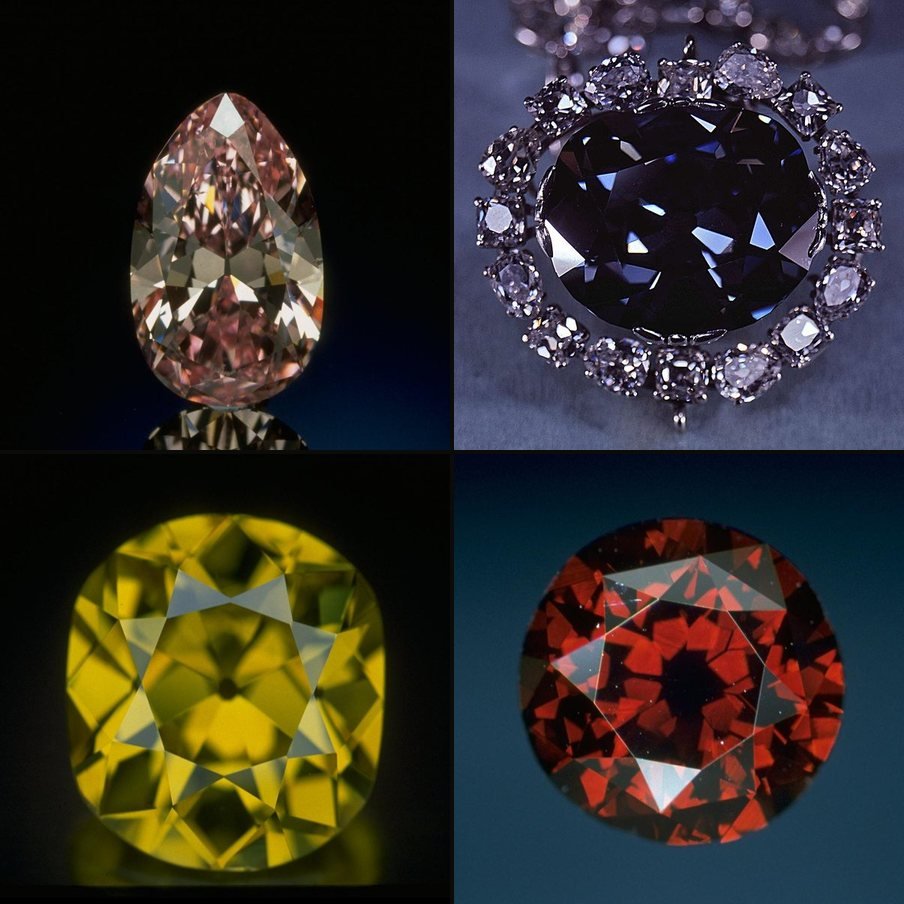
Pink, blue, yellow or green diamonds are not graded on the D-to-Z scale. The GIA describes the strength of the color with terms ranging from Faint to Fancy Light and Fancy, up to Fancy Intense, Fancy Vivid, Fancy Deep and Fancy Dark. In general, Intense and Vivid are the rarest and most expensive grades, and the most valuable colors are pink, blue and green5, 6.
For a colored diamond there is an even more important item: the origin of the color. The report states whether the color is natural or the result of a treatment. Treated color is worth much less and cannot be told apart with the naked eye: that is why every colored diamond should be examined by a laboratory.
Natural or laboratory-grown
Today there are also laboratory-grown diamonds, which have the same composition as natural ones but cost much less. Since October 1, 2025 the GIA no longer gives these diamonds 4C grades: it classifies them only as “Premium” or “Standard”, and laser-inscribes “Laboratory-Grown” and the document number on the stone. If a laboratory-grown diamond does not meet the minimum requirements, the GIA does not assess it at all7, 8.
For an investor the difference is decisive: long-term value depends on rarity, and rarity belongs to natural diamonds.
How to verify a report
Every GIA report has a number. With the free GIA Report Check service9 on the GIA website, you enter the number and see the data recorded by the laboratory: this immediately shows whether the document is authentic and matches the stone. The same number is often laser-inscribed on the edge of the diamond and can be read with a loupe.
What the report does not tell you
The report describes the stone, but it does not state a price or how much you could get by reselling it. There is no official daily price for diamonds, as there is for gold, and the gap between the retail purchase price and the resale price can be wide. That is why a diamond should be seen as a long-term holding, bought only with a report from a recognized laboratory and from a trusted seller.
On Selected Luxury Invest
On the Investment Diamonds page you will find a selection of natural colored diamonds. You can request information through the form on the page, and also a video call with the Milan showroom.
This article is for information only and is not investment advice. Before buying a diamond, always verify the report and ask an independent expert for an opinion. America Welcome Inc. is a branding and marketing company.
Sources
- GIA — Diamond Color: the D-to-Z scale
- GIA — Diamond Clarity: the clarity scale
- GIA — Diamond Cut
- GIA — Diamond Carat Weight
- GIA — Colored Diamonds Buying Guide
- GIA — Fancy Color Diamond Quality Factors
- GIA — New descriptive terminology for laboratory-grown diamonds (press release)
- GIA — Updated laboratory-grown diamond services launch October 1 (press release)
- GIA — Report Check: online verification of reports
Images: Selected Luxury Invest archive; colored diamonds — Smithsonian Institution, National Museum of Natural History (CC0) and Smithsonian Institution Archives (public domain).